How to Spot a Hazardous Leaning Tree Before the Next Storm: 7 Critical Warning Signs
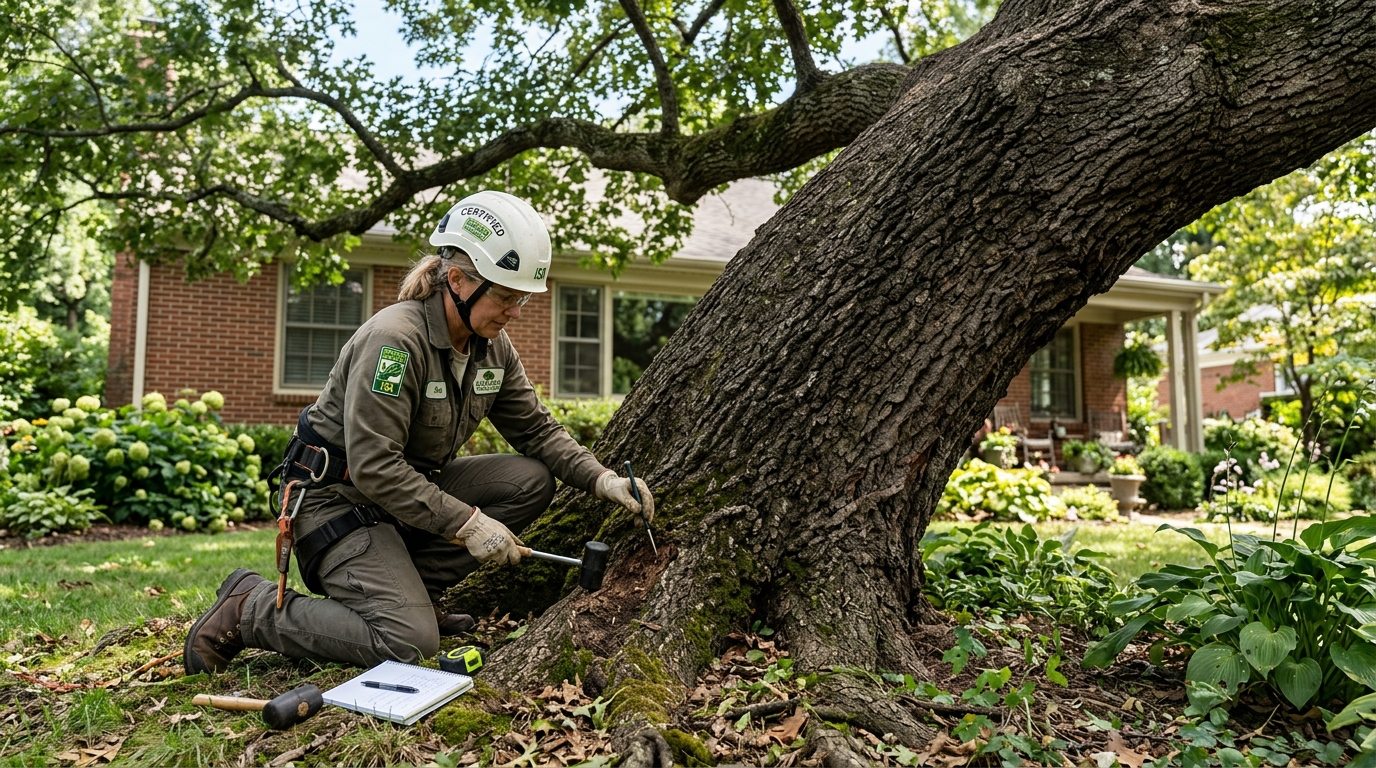
A tree is at acute risk of falling if you observe: 1. Soil mounding or heaving opposite a new lean. 2. Fungal brackets (conks) clustered around the root flare or lower trunk. 3. Deep vertical cracks or seams penetrating the heartwood. 4. V-shaped co-dominant stem unions with included bark. 5. Hollow cavities with more than 60% internal wood loss. 6. Extensive canopy dieback and dead branch clusters. 7. Sudden increase in lean angle following heavy rain or wind.
Homeowners often overlook subtle warning signs because trees appear outwardly lush and green during the growing season. However, wood-decay fungi and root shear often destroy a tree's internal load-bearing structure long before foliage shows signs of distress. In McKeesport and the Monongahela Valley, where steep slopes and clay soils amplify mechanical stress during weather events, identifying these red flags early allows you to arrange hazardous tree removal before gravity takes over and forces an emergency tree removal in McKeesport onto your roof.
1. Soil Mounding & Root Plate Heave Opposite the Lean
Differentiating between a harmless natural lean and an active mechanical failure is the most important skill in tree risk assessment. Many trees grow with a natural curve as they reach for sunlight (phototropism); these trees develop dense compression wood to support their shape over decades.
In contrast, an active failure lean occurs suddenly. Look at the ground directly opposite the direction the tree is leaning (the tension side). If you see raised turf, cracked soil, or root fibers exposed and pulling out of the earth, the foundational root plate has sheared. A tree with active root heave can collapse at any moment without wind.
2. Fungal Conks (Mushrooms) at the Root Flare
Fungi are nature's wood recyclers. When you see shelf-like bracket fungi (such as Ganoderma applanatum or Inonotus) or clustered mushrooms growing directly out of the bark or root flare, it indicates that mycelium has extensively decomposed the internal heartwood into brittle cellulose or sponge-like lignin.
While saprophytic mushrooms growing on nearby mulch are harmless, any fungal fruiting bodies attached directly to living trunk wood prove advanced structural decay. The tree has lost its modulus of rupture and cannot withstand gale-force winds.
3. Co-Dominant Stems with Included Bark
A structurally sound tree has a single dominant leader trunk with branches emerging at wide, U-shaped angles. When two or more main trunks grow upright together in a tight V-shape, the bark between them is pinched rather than fused with connecting wood fibers. This condition is known in forestry as included bark.
During severe windstorms or heavy winter snow, the two stems act like wedges, forcing each other apart. Severe Mon Valley ice storms frequently trigger catastrophic splitting along included bark seams, dropping half of the canopy directly onto houses or power lines.
4. Deep Vertical Seams & Torsional Fissures
Superficial bark cracks are normal as a tree expands. However, deep vertical seams that penetrate through the sapwood into the heartwood indicate catastrophic torsional shear. If you can see light through the split, or if the seam weeps dark bacterial slime ("flux"), the structural integrity of the trunk is broken.
5. Trunk Cavities & Significant Wood Loss
Old pruning wounds or mechanical impacts can rot out hollows inside a tree. Arborists apply the "one-third rule": if more than 30% to 35% of the trunk's diameter is hollow, or if the remaining sound wood shell is less than one inch thick for every six inches of trunk diameter, the risk of trunk snapping increases exponentially under storm gusts.
6. Upper Canopy Dieback & Clustered "Widow-Makers"
A tree struggling with dying roots cannot transport water and nutrients 60 feet up into its canopy. When top branches lose leaves, turn brittle, or snap and remain dangling in the crown, they represent immediate impact hazards known as "widow-makers." These can dislodge in a minor breeze. If your tree has heavy hanging deadwood, schedule immediate emergency limb removal before someone walks underneath.
7. Carpenter Ant Frass & Woodpecker Cavities
Carpenter ants do not consume wood; they excavate nests inside soft, already-rotting wood. If you see piles of fine wood sawdust (frass) accumulating around the base of a trunk, or if pileated woodpeckers are aggressively drilling deep rectangular holes, they are excavating insects living within extensive hidden interior rot.
Comparison: Safe Phototropic Lean vs. Dangerous Root Failure
| Characteristic | Safe / Benign Natural Curve | Critical / Hazardous Structural Failure |
|---|---|---|
| Trunk Shape | Sweeps or curves back upright toward top | Straight trunk leaning rigidly from the root plate |
| Root Flare Condition | Soil is firm and flat; root buttress is massive | Soil is cracked, mounded, or lifting on tension side |
| Lean Timeline | Unchanged for decades | Developed or worsened following recent storm or rain |
| Bark at Ground Line | Smooth, unbroken connection to earth | Exposed fibrous roots, tears, or fresh soil gaps |
What to Do if You Discover These Signs on Your Property
If you identify active root heave, deep structural trunk seams, or heavy conk clusters on a tree within striking distance of your home, do not wait for the next storm front. In confined spaces or near overhead utilities, professional crews utilize crane-assisted tree removal to lift hazardous timber away safely without risk of premature ground collapse.
Worried About an Unstable Tree on Your McKeesport Lot?
Our dispatch desk connects you with certified tree risk assessors and emergency takedown crews immediately.
Call for Immediate Dispatch: (412) 658-9875